...

.
Showing posts with label Katharina Grosse. Show all posts

Friday, December 24, 2010

Katharina Grosse


Katharina Grosse

Katharina Grosse at MASS MoCA.


boards used to cover the window for jenny holzer's show were recycled as masking for this wall... they don't waste anything at this museum (for example sitting in christoph buchel's abandoned theatre seats to watch guy ben-ner's mocking video).


side by side BUILDINGs-ful of Katharina Grosse and Sol Lewitt wow.


Katharina Grosse

She gave a wonderful talk I attended in 2005 -
Katharina Grosse lecture Part 1
Katharina Grosse lecture Part 2
Katharina Grosse lecture Part 3


more pictures on my flickr


lines


Katharina Grosse
KG

Sunday, June 26, 2005

Katharina Grosse at Solvent Space

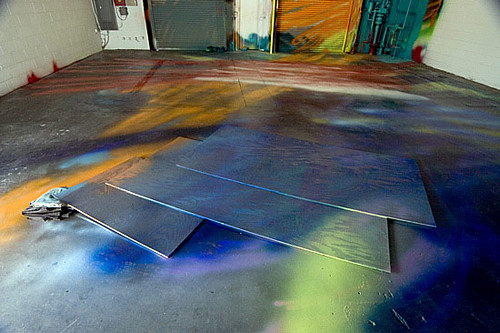
The Katharina Grosse show at Solvent Space closes July 9th. More images here. That big white space on the wall was created by working over this piece of wood and later removing it. The removed piece was placed vertically in a separate room which was left otherwise untouched.
Who's next? Daniel Buren? Ann Hamilton? Dennis Oppenheim? I hope Daniel Buren comes back.
Related - Katharina Grosse lecture blogged here and here. Installation visit here.

Friday, April 22, 2005

Katharina Grosse lecture Part 3

.
Continuing with the recent Katharina Grosse lecture - the previous post is here.

After all of these big public projects Grosse wanted to work in her own private sphere - she ended up doing her own bedroom. I have no idea how much of this remains, can't imagine sleeping on a spray-painted bed is very comfortable. Makes me think of Rauschenberg's bed.

The next public project was in a big cube space and she needed something little to draw people in and break up the space - so she put a bed in it. The bed is a type of "space unit". This is kind of interesting - a room is a space unit, a bed is a space unit, your clothes are space units, even a book is a space unit. I'm not sure exactly what she means by this but it is interesting to think about your clothes and books as "space units" and wonder where Grosse might go with the idea. Her paintings already include a time element in the "negative image" left behind when she paints over something like a door handle, a book has a whole other way of thinking about both space and time.

She ended the lecture with photos from her last show at Christopher Grimes. This looks like it was a really cool show. She had a room with a futon on the floor painted over, spraypaint on the walls, along with "straight" paintings. She placed a big stretcher on one wall before she went to down on it with her spray gun and afterwards removed that painting, leaving a big white rectangle on the wall. The removed painting is beautiful! For some reason I immediately thought of some of the landcsapes I saw in the the fantastic American Sublime show a few years ago. It was like a big South American rainbow Frederick Church painting. Most of her straight paintings are big circles, or include colored circles or dots - these are a reference to the little drops of spray that edge any sprayed wall piece.

After the lecture Gregory Volk had a question about her process - how much does she plan beforehand? She answered that at first she would make little models of the spaces she would be working in and set up all sorts of rules for herself but now she works much more intuitively. No models, no prefabricated ideas, more about the time and the amount of materials available and the size of the space. Her use of color is dependent on both the light situation and simply how much of a color she has available. Probably the best thing she said is that she freed herself to do anything by understanding that "There is no way it can go wrong. That's clear now but it took a while to understand it."

Friday, April 15, 2005

Katharina Grosse lecture Part 2

.
Continuing with the recent Katharina Grosse lecture - the previous post is
here.

The projects in Marfa and Helsinki with their big windows helped to open up new relationships between the building and the painting. Another project, a little barn in Switzerland, was a challenge because she wasn't allowed to work directly on any of the old barn's surface. For this tiny low-ceilinged space she decided she would try to make the largest painting possible for that little structure. They built false walls and a lowered ceiling within the space to paint on - can't find a pic for it yet, sorry. Grosse says she is open to experimenting with building her own structures but only when she can't use the given space.

This Hammer Museum painting in a stairwell was created two weeks after 9/11 - she said it was a very tense situation in LA (I guess when she was doing this we all know exactly where we were too - I think almost every artist talk I've been to in the past couple years the speaker has mentioned 9/11, regardless of where they were when it happened). Grosse said she is fascinated by stairwell situations in which people move along her painting. Much different than something that people walk up to and stand in front of. They should move that Matisse in the MoMA and let Grosse do something there. She'd be a great candidate for the Philly ICA ramp as well.

One of the most interesting parts of the lecture was her description of her working conditions. The working conditions of these wall spray-pieces have nothing to do with how they are eventually viewed. We think of these paintings as being site-specific pieces but the idea of a site-specific work is really sort of a metaphor because she is so disconnected from the environment. To prevent spray dust from going all over it is necessary to completely seal off the area she works in with large sheets of plastic - sometimes it is dark plastic. Grosse wears a spraysuit, goggles, a mask, and even ear mufflers. The compressor creates a huge amount of noise. She's like an astronaut and can't even hear her own footsteps because of the ear mufflers.

Working in a big complicated space like this one it is impossible to see everything while you are working on it - she needs to memorize. She compared this piece to like taking a hike - with different views and vantage points. The ceiling here is ribbed or corrugated so what you see looking up from one side is different from what you see looking up from the other.

Part 3

Katharina Grosse lecture Part 1

.
The Katharina Grosse lecture yesterday was inspiring - if you didn't go you missed out. She shared so much yet I think we only got a glimpse. Here are my notes - feel free to add subtract negate extol decry in the comments:

Katharina Grosse studied in Dusseldorf, a Richmond-sized city, under Gerhard Richter and Jorg Immendorf (and the shadow of Beuys) and along with Thomas Struth, Andreas Gursky, and Katharina Fritsch. That might not be exactly right but the first artists were the big local influences at her school and the younger three were peers she had frequent contact with.

Photography was THE THING and she had to deal with the ongoing problem of being confronted with "painting is over" and having to defend the medium. She talked about going out for beers with artist friends who would ask "what did you do today?" to which she would answer "paint" and they would respond with "why?". Very frustrating.

Nam Jun Paik also taught while she was studying there and so she tried to get into video and photography and other things but after two or three years she didn't know what to do anymore and realized that the only thing all her experiments in different media had in common was the use of color. She decided to go back to painting.

The first question she asked herself after accepting herself as a painter was "should paint be thick or thin"? She thought "it should be very present" and so chose thick. She made some works with really thick blobs of paint but after they dried some of them would slide off the canvas so she thought "maybe that's the wrong way to go, maybe I should go thin".

Her first thin paintings were very simple strokes of overlapping color left to right and top to bottom. Painting a second color over the first had the effect of taking a quantity away. It was a way of mixing colors and making the colors ambiguous. What looks "blue" can't so easily be called "blue".

An opportunity came up to paint directly on the wall for a company cafeteria/break-room and she was happy with the results, thinking the workers would like it because it was "very colorful, very beautiful" - unfortunately the work was not popular with the staff, who said it was "not a painting". Another opportunity to paint directly on a wall arose and she was especially interested in that piece's relationship with a nearby door.

Then in 1998 she was invited to participate in a museum show in Switzerland in which they said she could do whatever she wanted. She visited the space and decided she should have a painting in the corner, not centered on any of the walls. This dark green rectangle was her first spray piece and one of the exciting things she learned making it was that the corner would disappear - "I was creating an illusionistic space within the built space".

As an artist-in-residence at Marfa she was able to make a work that related to the whole building. The exciting discovery here was in painting over the door in the middle of the wall and making a painting you could "walk through" (I'm starting to think of James Hyde and his handles - another painter whose work seems to want to take us somewhere). The door in the Marfa building is a very specific door - not your generic door - which lent the piece added narrative. Sort of ominous.

The other big thing learned painting over this door in Marfa was in painting over the door's handle - spraying over the handle left an after-image behind it. This was her first time to notice this time element adding effect.

Part 2