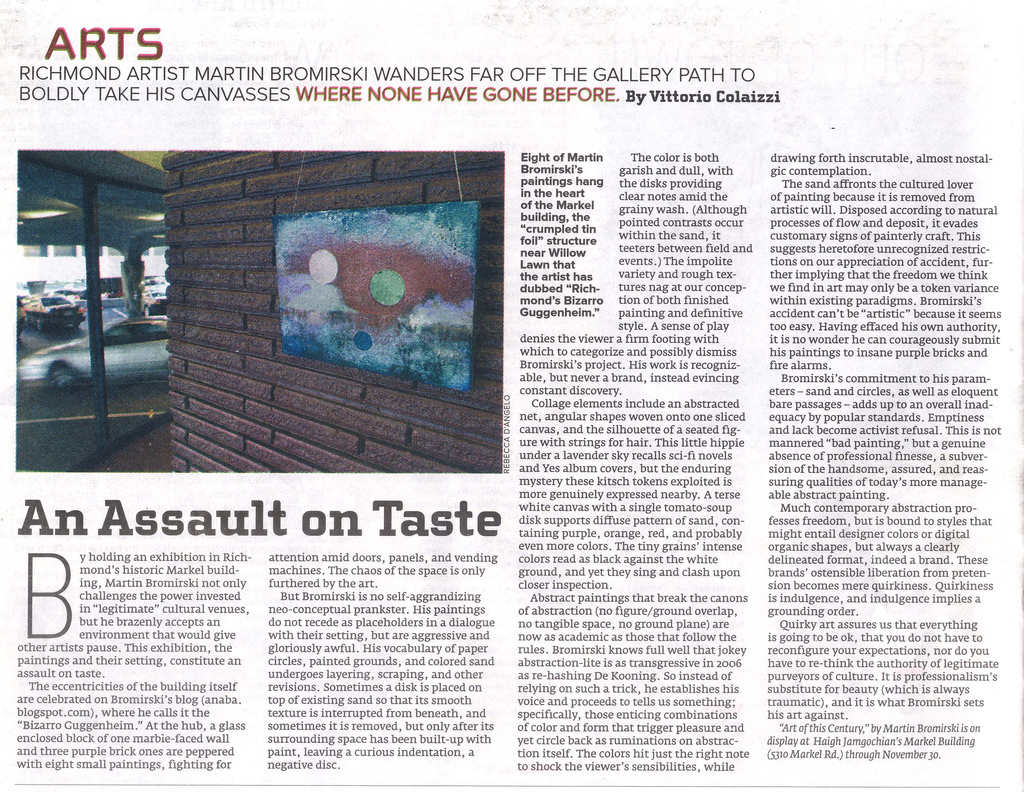
I've added links to things -
Redefining the Center
Jason Coates
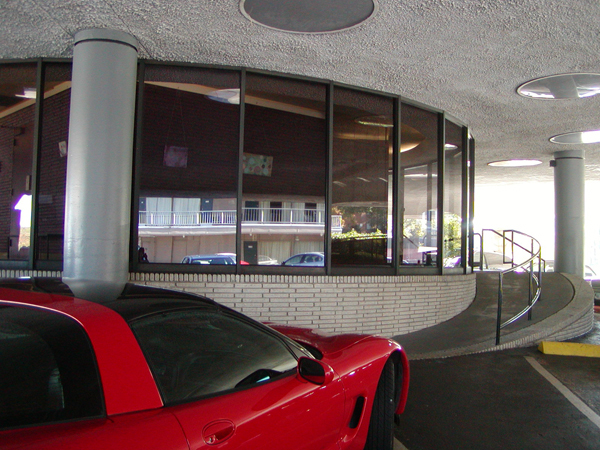
When discussing Martin Bromirski's one person show at Haigh Jamgochian's wonderfully out of place Markel Building in Richmond, VA, it is quite possible to focus only on the near-perfect matchup between the small group of paintings and the site. For starters, Jamgochian's office building- which resembles a gigantic flying saucer plopped down amid the car dealerships and strip malls on West Broad Street, has the same future-as-imagined-from-the-past quality that Bromirski's misty abstracts capture. Bromirski has a knack for redefining the center, often creating art venues where there were none. He's accomplished this with his popular art blog anaba.blogspot.com, his mock Art Basel at Stuffy's Sub Shop in Richmond, and now this show at what Bromirski deems the "Bizzarro Guggenheim". But equally as interesting is the way that the paintings ask you to imagine where they have been.
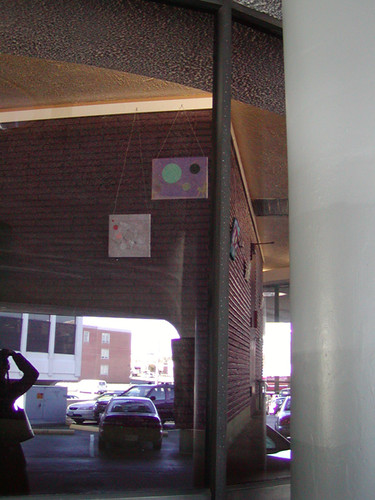
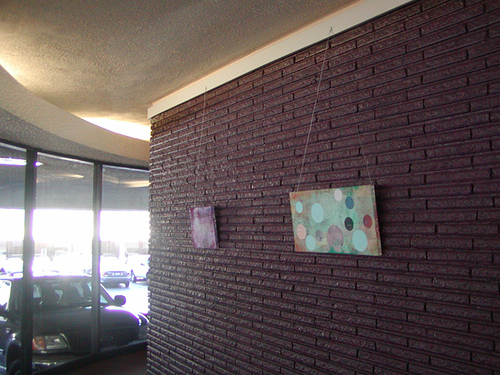
The handful of small paintings are hung in a circular lobby among an elevator entrance and vending machines. Yet, even in this modest setting, Bromirski's paintings appear unassuming- almost tailor made to blend into the space. It is this unassuming quality- bordering on sweetness and pathos- that sets this work apart from his earlier, grander paintings. Previously, Bromirski's large scale work would center around a tiny, barely recognizable figure dwarfed by it's surroundings . In the new body of work, the individual paintings become characters themselves, ready to be crammed into a suitcase like a stack of dog-eared postcards and rushed off to the next adventure.
The vocabulary in the paintings is limited: each containing one or more circular elements fixed atop a hazy backdrop. Many Japanese landscape drawings make use of the sun as a balancing device, acting like a free-floating punctuation mark above the picture plane. Bromirski focuses only on this sun-shape, doing away with the rest of the picture. The sun-shapes have various colors and moods. Some rub up against each another and appear to socialize, some seem quite and contemplative.
If Bromirski's work has always dealt, in some way or another, with accumulation of experience, the new paintings wear that experience on their skin. Often the sun-shapes are cut from the paintings, reveling the layers beneath. Bromirski uses colored sand and acrylic paint to build complex, pockmarked surfaces. The result is a nebulous environment that is both ethereal and terrestrial, like the surface of the moon. In my favorite work in the show, hung just to the right of a snack machine, Bromirski lovingly repairs a large gash formed at the center of the painting by weaving it back together and dousing it with silver paint. The care with which the painting is mended is visible, and makes one wonder how (or why) it got gashed in the first place.
In an art world where the more-is-more aesthetic has become so commonplace that it can't be called brash anymore, it is nice to see an off-the-beaten-path and understated show like Art of This Century. It is a show that stokes a desire to see more, rather than pounding the viewer over the head with everything within reach. While many artists confuse making a lot with saying a lot, Bromirski clearly knows better.
- THanKS, Jason!
PLUS: Vittorio Colaizzi's review of the same show... An Assault on Taste!!!
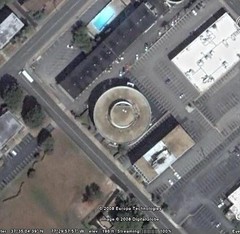
Haigh Jamgochian's Markel Building, Richmond VA.... FROM SPACE.